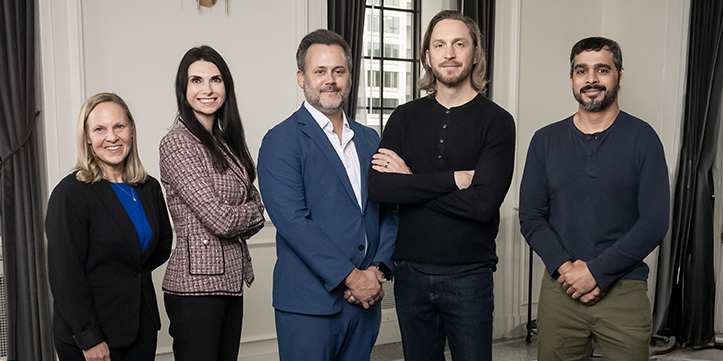
Photo: Rivermark team members (from left to right)—Tristen Moors, Vice President Clinical Operations; Jaime Walkowiak, Executive Vice President of Operations; Greg Borecki, Vice President Market Development; Adam Kadlec, President & CEO; Andy Doraiswamy, Board Chairman
For nearly 40 million men in the U.S., Benign Prostatic Hyperplasia (BPH) it is life-altering—impacting everything from sleep to confidence to quality of life. For decades, the treatment paradigm has remained largely unchanged: medication first, and if that fails, irreversible surgery. It’s a clinical limbo that leaves too many patients underserved.
That’s where Rivermark Medical comes in. Co-founded by urologist and CEO Dr. Adam Kadlec, Rivermark is developing the FloStent™ System, a minimally invasive, reversible device therapy designed to be delivered in the same visit as a diagnostic cystoscopy and rapidly restore normal urinary flow—no surgery, no hospital, no capital equipment. For patients, it means faster relief and more choices. For providers, it means a practical, scalable way to treat BPH earlier and more effectively.
In this interview, Dr. Kadlec shares the personal experiences that inspired Rivermark’s founding, the real-world impact of their SSBCI-backed funding round, and what it means to build a durable medical device business from his home base in Wisconsin. His journey offers insight not only into where the standard of care is headed—but how it gets there.
What inspired you to start Rivermark, and what specific problem in BPH treatment were you setting out to solve?
AK: As a practicing urologist, I was seeing a lot of BPH patients. I was counseling people, doing procedures, prescribing medications. And even though treatment options have increased significantly over the past 10 or 15 years, what always seemed to be lacking was a logical first-step option.
Traditionally, we prescribe a daily medication first—something like a blood pressure pill. It doesn’t cure the condition but controls it. If the medication fails, patients then move on to procedural therapy.
But the problem is that all the procedural options are irreversible, and many patients are stuck in this limbo where they’re not happy on meds, but not ready for surgery. I found myself wishing I had something reversible I could offer—something patients could “try on” like a medication, but without the burden of taking pills every day. That’s what sparked Rivermark.
For those unfamiliar with BPH, what does the current patient experience typically look like?
AK: I always tell people—first of all—you’re in good company. BPH is extremely common. Every man around age 50 undergoes hormonal changes that cause the prostate to grow—not cancer, just benign growth. As it grows, it narrows the urinary channel and causes bothersome urinary symptoms.
Most men tolerate those symptoms for a while, hoping they’ll go away—kind of like ignoring a roof leak. Eventually, when it gets bad enough, they see a doctor. That’s usually their primary care provider, who may prescribe medication or refer them to a urologist.
At that point, they might hear about procedural options, which range from minimally invasive treatments to full surgical interventions. But again, there’s not much in the middle ground—and that’s what we’re trying to change.
What makes the FloStent™ System a meaningful advancement in BPH treatment?
AK: FloStent truly has the potential to change the way BPH is treated. It gives us a way to redefine the care pathway.
Right now, the typical path is: symptoms > medication > irreversible procedure. FloStent offers a non-surgical, reversible option that patients can try early—something that competes with medication but avoids long-term commitment or tissue damage.
One of the most exciting aspects is that it can be delivered during a diagnostic cystoscopy, which urologists already perform all the time. That means we can go from diagnosis to treatment in the same visit—no waiting, no pre-op, no surgery.
It’s also cost-effective and capital-free, so it doesn’t require expensive equipment. That opens doors not only in the U.S. but globally—especially in markets where cost is a major barrier to care. In places like Europe or developing countries, where device therapies for BPH are rare due to pricing, FloStent could fill a huge gap.
Congratulations on enrolling the first patient in your RAPID III trial. What does this milestone mean for you and your team?
AK: It’s a big deal for all of us. There’s an incredible amount of work that goes into starting a trial like this, so just getting it off the ground is worth celebrating.
To see the device in the hands of physicians I know—colleagues, peers, even friends—has been very cool. And to see it going into real patients here in the U.S. is incredibly gratifying.
We’ve done trials outside the U.S. before, and I still remember speaking to our first patient post-procedure. He walked away happy with the device in place. That left a lasting impression on me.
Now, I’m watching our team experience that same fulfillment—seeing them engage with clinical sites, physicians, and patients. It’s a lot of work, but it’s really rewarding.
You’ve described FloStent as a “first-line device” with zero capital requirements. Why is that model so important in today’s healthcare landscape?
AK: Because first-line treatment is where most of the patients are. For a high-volume condition like BPH, being the first treatment option unlocks massive clinical and commercial potential.
From a business standpoint, it’s a volume play: lots of patients, lots of procedures. Add in low manufacturing cost, no capital equipment, and a reimbursable pathway, and each procedure becomes not just effective for the patient—but profitable for the provider.
Innovation is important, but I’ve also learned that you need to get paid for the work you do. FloStent gives us the foundation for a strong, sustainable business.
Your latest funding round included support from the Wisconsin SSBCI program. What did that funding make possible for Rivermark?
AK: It really helped catalyze the round. Venture Investors Health Fund brought in capital through the SSBCI program, and it was a significant amount—money we could count on.
When you’re trying to build a syndicate, knowing a lead investor is committed and has dollars earmarked for Wisconsin-based companies makes a huge difference. It helped us maintain momentum and ultimately close the round successfully.
Every dollar we raised is going into clinical development—into hiring the team, running the trial, and pushing the product forward.
Why is Wisconsin the right place to grow Rivermark?
AK: I didn’t want to uproot my family or move across the country to build something meaningful.
Rivermark is a virtual company. I live here, and we pull talent from everywhere. Our headquarters is Wisconsin, and we’re proud of that.
There’s real talent here, and while not every region has a full-blown life sciences ecosystem, what matters is connecting people to ecosystems. If you invest in people, they’ll find ways to thrive.
Personally, this state has given me a lot. I moved here at 16, went to UW-Madison for undergrad and med school, and now I’m raising my kids in Milwaukee. It’s important to me to give back.
What has it been like working with Venture Investors Health Fund—and how has their support shaped your journey?
AK: It’s been great. What’s special is that our relationship started long before they invested a dollar. We got to know each other and built trust.
By the time I called Scott Button to talk about the round, there was already a shared understanding. Since then, they’ve done exactly what good investors do: they connect you with people in their network, they check in, and they’re proactive.
I don’t need to chase them down for help—Scott’s usually already thinking about how to help before I ask.
What advice would you give to other founders navigating early-stage growth and public-private partnerships like SSBCI?
AK: I don’t pretend to have all the answers—it’s my first company—but I’ve learned that fit matters. The right investor fit is just as important as the idea itself.
I also say: start by getting started. You can plan and strategize all you want, but you have to pitch. You’ll fail a lot early on, talk to the wrong people, knock on the wrong doors. But eventually you’ll find the right one.
And expect your playbook to evolve. Our product vision hasn’t changed, but our fundraising, team-building, and execution strategies definitely have. That’s part of the journey.
Whether or not it directly relates to Rivermark—what excites you most about the future of medical device innovation?
AK: There’s always a need. Populations are aging, chronic disease isn’t going away—and the potential for impact is massive.
What excites me most is not just what’s possible, but learning how to build commercially viable products that scale. You can build amazing things as an engineer or a clinician, but translating that into a real business—that’s the challenge.
I hope FloStent is just the beginning of my career. I want to build more companies, solve more problems. There’s a lot more to write.
Learn more about Rivermark at rivermarkmedical.com.
Note: This interview was lightly edited for readability.